OEM Tools 27110 Oxygen Sensor Socket vs Impact Socket Set: Which Tool Fits Your Sensor Job?
Removing an oxygen sensor without the right tool often ends with rounded flats, broken wiring, or hours of frustration. The OEM Tools 27110 oxygen sensor socket uses a slotted design that clears the sensor’s wire harness, while a standard impact socket set lacks that clearance and risks crushing the connector.
We designed the 27110 to address the one problem every technician faces: sensors installed in tight exhaust manifolds with cables running perpendicular to the hex. A conventional deep socket can’t slip over the body without damaging the wire. Understanding which tool matches your sensor type saves both time and replacement parts.
Why Slotted Sockets Exist: The Wire-Harness Clearance Problem
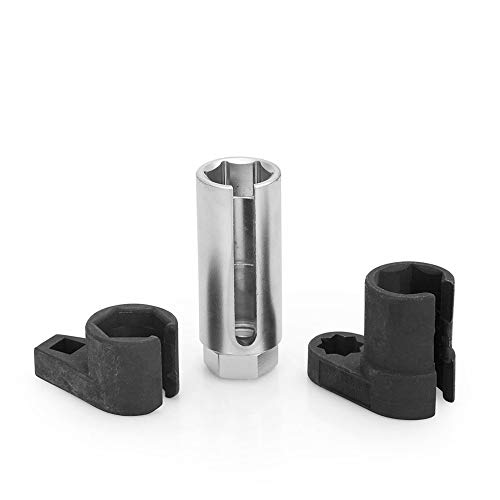
Most vehicles since the mid-1990s mount oxygen sensors directly into the exhaust manifold or downpipe with a permanent wiring pigtail extending from the threaded body. That cable exits at a right angle to the hex flats, so a traditional six-point socket can’t slide onto the sensor without bending or severing the wire.
The 27110 cuts a channel along one side of the socket wall, allowing the cable to pass through while the hex engages the sensor’s 7/8-inch or 22-millimeter flats. This same design principle appears across professional automotive hand tool standards, where task-specific geometry prevents component damage during service. A standard deep socket from an impact set will contact the wire boot before the hex seats, forcing the technician to either remove the connector—often impossible on upstream sensors with heat-fused pins—or abandon the tool entirely.
Material and Drive-Size Differences Between Dedicated and General Sockets
Wall Thickness and Torque Capacity
Oxygen sensors rarely require more than 30-40 lb-ft removal torque when freed with penetrating oil, so the 27110’s thinner wall around the slot doesn’t compromise strength for this application. Impact socket sets built for lug nuts and suspension bolts use thicker chrome-moly walls to handle 150+ lb-ft breakaway loads, but that extra mass becomes a liability in confined exhaust spaces.
Drive Configuration
Our 27110 ships with a 3/8-inch drive to match the ratchets most technicians already carry for exhaust work. Many impact socket sets include 1/2-inch drives optimized for wheel and drivetrain fasteners, which require an adapter for oxygen sensor removal and add length that blocks access near catalytic converter shields. The smaller drive also reduces the risk of over-torquing a replacement sensor’s steel threads into an aluminum manifold.
When a Standard Deep Socket Actually Works
Pre-1996 vehicles sometimes used oxygen sensors with detachable connectors mounted several inches away from the threaded bung, leaving enough slack to rotate the sensor body independently. In those cases a conventional 7/8-inch deep socket from an impact set will remove the sensor without wire interference.
Similarly, some aftermarket wideband oxygen sensors for performance tuning use a two-piece design where the cable unscrews from the sensor body. If you regularly work on carbureted engines or pre-OBD-II trucks, a general socket set may already cover your sensor jobs. For modern vehicles with integrated harnesses, the slotted tool remains the only reliable option.

Organizing Both Tool Types in a Mobile Cart
Professional shops often store the 27110 alongside exhaust-specific tools—penetrating oil, anti-seize compound, and wire-brush attachments—rather than mixing it into the main impact socket rails. This separation prevents technicians from grabbing a standard deep socket out of habit when the job ticket specifies sensor replacement.
We’ve seen service bays use magnetic trays and tilt-bin organizers to group exhaust tools by system rather than by tool type, so oxygen sensor sockets, manifold flange wrenches, and clamp pliers stay together. That workflow reduces the time spent hunting for the right tool when an upstream sensor fails during a routine inspection. Some techs also appreciate finding storage solutions through resources like specialized tool retailers that carry accessories for mobile cart setups.
Matching the Socket to the Sensor Job
The choice between the OEM Tools 27110 and a standard impact socket set comes down to wire-harness geometry. Modern vehicles with integrated sensor cables require the slotted design to avoid connector damage, while older systems with detachable harnesses work fine with general deep sockets.
For shops servicing a mix of pre-OBD-II and late-model vehicles, keeping both tools on hand eliminates guesswork. The 27110 handles the majority of sensor replacements on 1996-and-newer cars, and a conventional 7/8-inch deep socket covers legacy applications. Invest in the right tool once, and oxygen sensor jobs shift from multi-hour frustrations to routine 15-minute swaps.
Common Questions About Oxygen Sensor Removal Tools
Yes, the 27110 is impact-rated and compatible with 3/8-inch drive impact wrenches. Use low-torque settings to avoid stripping the threads in aluminum manifolds.
Most oxygen sensors break free at 25-35 lb-ft, so a hand ratchet with penetrating oil is often sufficient. Reserve the impact wrench for severely corroded sensors that don’t move after soaking.
The 27110 is sized for 7/8-inch flats, which measure 22.225 millimeters. That 0.225mm difference falls within the socket’s tolerance, so it engages both imperial and metric sensors without rounding.
Some European vehicles use 18mm or 24mm sensors that require separate sockets. Check your vehicle’s service manual before ordering.
Modern sensors ship with a nickel-based anti-seize coating pre-applied to the threads. Adding more compound risks contaminating the sensor element if excess paste migrates past the threads during installation.
If you’re reusing an old sensor for testing, clean the threads with a wire brush and apply a thin layer of high-temperature anti-seize rated for exhaust applications. Torque to the manufacturer’s spec, typically 30-37 lb-ft.
Downstream sensors installed after the catalytic converter often sit in recessed bungs surrounded by heat shields and crossmember tubes. A standard deep socket’s straight wall can’t clear those obstructions, even if the wire harness isn’t blocking access.
The 27110’s slim profile and offset design reach sensors in tight quarters where general sockets bottom out against surrounding components. Some jobs also require a flex-head ratchet or crowfoot adapter.
Grinding a slot weakens the socket’s structure and often leaves burrs that damage the sensor’s wire insulation. Professional slotted sockets are machined with radiused slot edges and heat-treated after cutting to restore strength.
The cost difference between a modified socket and a purpose-built tool is small enough that most technicians choose the factory option to avoid warranty issues and repeat purchases.
Spray penetrating oil around the sensor’s hex base and let it soak for 15-20 minutes. Attempt to rotate the sensor a quarter-turn by hand using the socket and ratchet—no impact wrench yet.
If the sensor doesn’t budge, apply heat to the bung area with a propane torch for 30-45 seconds, keeping the flame away from plastic wiring and rubber hoses. Seized sensors often require three heat-and-penetrate cycles before they break free.